

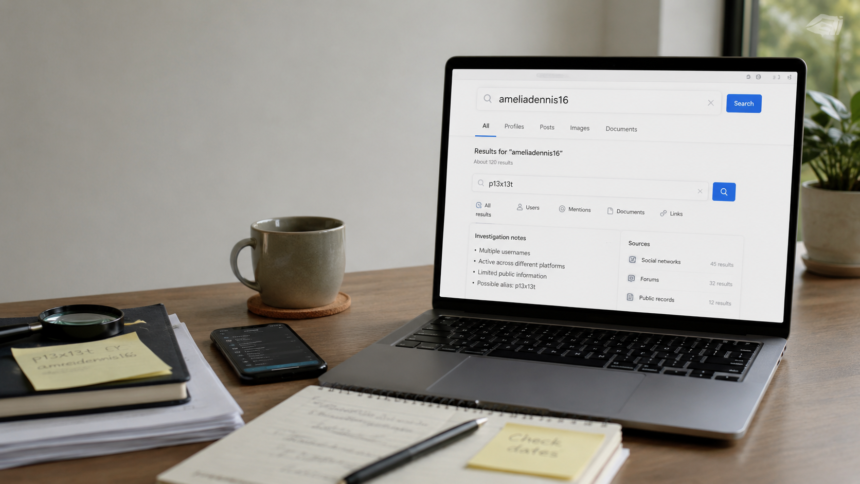
The keyword ameliadennis16 has begun appearing across search results, blogs, and discussions about online identities. At first sight, it looks like a straightforward personal username: a first name, a surname, and a number. The growing interest around it, however, has created a much bigger question—who or what does ameliadennis16 actually represent?
The most important point is that there is currently no authoritative public source confirming the identity behind the exact username ameliadennis16. Some websites connect the keyword with psychologist Dr Amelia Dennis, while others simply describe it as an online handle. That difference matters because an online similarity is not enough to prove ownership.
A responsible look at ameliadennis16 therefore requires separating what can be verified from what remains speculation.
What Is Ameliadennis16?
At its simplest, ameliadennis16 appears to be an online username or search keyword.
Its construction follows a familiar pattern used across social networks, forums, gaming platforms, and other online communities. “Amelia” and “Dennis” resemble personal names, while “16” may have been added to make the username unique.
The number itself does not have a publicly verified meaning. It could represent a favorite number, year, age-related reference, or simply have been chosen because another version of the username was unavailable.
Several recently published websites have attempted to build a profile around the keyword. However, at least some of those pages acknowledge that there is no clearly verified public account establishing who owns it.
That uncertainty should be kept in mind whenever claims about the username are presented as fact.
Is Ameliadennis16 Amelia Dennis?
Some search results associate ameliadennis16 with Dr Amelia Dennis, a genuine psychology researcher whose academic work can be independently verified.
However, no reliable source located during research confirms that the specific username ameliadennis16 belongs to Dr Dennis.
This distinction is important.
There is strong evidence that Dr Amelia Dennis is an academic researcher. The University of Southampton currently identifies her as a Research Fellow whose work spans social and health psychology, including health behavior, well-being, nostalgia, emotion regulation, and group processes.
What cannot currently be confirmed from authoritative sources is that she operates or previously operated an account called ameliadennis16.
In other words, the researcher is real and well documented, but the connection between her and this exact username remains unverified.
Who Is Amelia Dennis?
Dr Amelia Dennis is a psychology researcher with academic interests covering social psychology, health psychology, nostalgia, well-being, attachment, and behavior change.
Her academic history includes postgraduate research at the University of Surrey. A university profile describes her doctoral work as investigating the relationship between attachment dimensions and nostalgia, including whether nostalgia could potentially support feelings of attachment security.
Her more recent University of Southampton profile shows that her research has expanded across three broad areas: encouraging healthier behavior, understanding psychological well-being, and examining processes within social groups.
This established academic record is much stronger evidence than speculative biography pages built around an unexplained username.
Research on Nostalgia
One of the clearest themes in Amelia Dennis’s published research is nostalgia and psychological well-being.
Dennis and Erica Hepper published a review examining nostalgia as a potential resource for both hedonic well-being—such as happiness and life satisfaction—and eudaimonic well-being, which includes aspects such as meaning, positive relationships, vitality, and psychological functioning.
The review concluded that research has linked nostalgia with several positive well-being outcomes while also emphasizing the need for further longitudinal and experimental studies.
That nuance is important. Academic psychology rarely supports the type of absolute claims sometimes found in simplified online articles. Research findings usually describe patterns, probabilities, limitations, and conditions rather than universal outcomes.
Nostalgia During COVID-19
Dennis has also studied psychological interventions during the COVID-19 period.
A study published in the Journal of Happiness Studies compared interventions involving nostalgia, gratitude, optimism, and a control condition. Researchers examined whether these approaches influenced well-being during a period when social restrictions disrupted ordinary life.
The published study found evidence of benefits across several positive psychological approaches, although the effects differed depending on the outcome and point in time being examined.
Another study involving Dennis examined past-, present-, and future-focused interventions during lockdown. Participants were assigned activities involving nostalgia, gratitude, imagining a positive future, or a control task.
These publications provide concrete examples of the research associated with Amelia Dennis rather than relying on assumptions created from an online username.
Attachment and Memory
A 2026 study by Amelia Dennis, Erica Hepper, Tim Wildschut, and Constantine Sedikides explored how attachment orientation may influence nostalgic memories and their relationship with well-being.
The research examined written nostalgic narratives and considered characteristics including references to other people, social connection, the self, and emotional content.
The study involved hundreds of participants and found meaningful differences in nostalgic narratives depending on attachment-related characteristics. It was first published online in May 2026 in the Journal of Social and Personal Relationships.
This work fits naturally with Dennis’s broader research interest in the relationship between memory, relationships, emotions, and psychological health.
Why Is Ameliadennis16 Being Searched?
The curiosity surrounding ameliadennis16 may partly come from the structure of the keyword itself.
Personal-looking usernames naturally make readers wonder whether they belong to a creator, researcher, influencer, or ordinary social-media user. Once several websites publish pages around the same keyword, search engines can expose it to an even larger audience.
That can produce a cycle:
Someone encounters the name, searches for it, finds several speculative pages, and additional publishers then create content because the keyword appears to have search demand.
This process does not necessarily mean that the person behind the username has suddenly become famous.
Search visibility and real-world prominence are two different things.
Digital Identity Matters
The uncertainty around ameliadennis16 also illustrates an important issue in modern internet research.
A username can resemble someone’s real name without belonging to that person.
People frequently share identical or similar names, and usernames can be copied, reused, abandoned, or created by unrelated individuals. Numbers added to names make the possibilities even broader.
That is why responsible publishers should avoid connecting an unidentified account with a real person unless there is reliable evidence such as an official profile, institutional link, verified social account, or direct statement from the individual.
This principle protects both readers and the people being discussed.
Avoiding False Information
Readers researching ameliadennis16 should pay attention to the quality of the sources they encounter.
A page stating that someone has a particular career, age, location, relationship history, net worth, or social-media following should ideally show where that information came from.
If no original source exists, repeating the statement does not make it more reliable.
For information about Amelia Dennis the psychologist, university profiles, academic journals, PubMed, and research repositories provide considerably stronger evidence than anonymous biography websites.
What We Can Confirm
The evidence currently supports a relatively simple conclusion.
Ameliadennis16 exists as a searchable online term or username, but its ownership has not been reliably established through authoritative public evidence.
Dr Amelia Dennis, meanwhile, is a documented psychology researcher associated with research into nostalgia, attachment, well-being, health behavior, and social processes.
Some websites connect the two, but that connection should not be treated as proven until a primary or authoritative source confirms it.
This may sound less dramatic than many online explanations, but it is far more useful. When information is uncertain, saying so clearly is better than filling the gaps with invented details.
Final Thoughts
The interest in ameliadennis16 shows how easily an ordinary-looking username can develop an unexpectedly large digital footprint.
For readers trying to understand the keyword, the key is to distinguish between the username itself and people who happen to share a similar name.
Dr Amelia Dennis has a verifiable academic history and published research. The exact relationship between that researcher and ameliadennis16, however, has not been independently confirmed.
Until stronger evidence appears, ameliadennis16 is best described as an unverified online identity or keyword rather than an established biography of a specific public figure.
Frequently Asked Questions
What is ameliadennis16?
Ameliadennis16 appears to be an online username or search term. There is currently no authoritative public record clearly establishing who owns the exact username.
Who is behind ameliadennis16?
The identity behind the username has not been independently confirmed by a reliable primary source.
Is ameliadennis16 Dr Amelia Dennis?
Some websites associate the keyword with psychologist Dr Amelia Dennis, but authoritative sources located during research do not confirm that she owns or uses the exact handle.
Who is Dr Amelia Dennis?
Dr Amelia Dennis is a Research Fellow in psychology at the University of Southampton. Her research includes health behavior, nostalgia, well-being, emotion regulation, and group processes.
What does Amelia Dennis research?
Her published research includes nostalgia, psychological well-being, attachment orientation, health interventions, behavior change, and social psychology.
What does the number 16 in ameliadennis16 mean?
There is no verified explanation. It could have personal significance or simply have been added to make the username unique.
Is ameliadennis16 a celebrity or influencer?
There is no reliable evidence establishing the exact username as belonging to a widely recognized celebrity or verified influencer.
Why is ameliadennis16 appearing in Google searches?
Repeated publication and user curiosity can increase the visibility of unusual keywords. Search popularity alone does not establish the identity or importance of the person behind a username.
Is information about ameliadennis16 reliable?
It depends on the source. Claims about the username should be treated cautiously unless backed by a primary source, verified account, recognized publication, or institutional profile.
Where can readers find reliable information about Amelia Dennis?
University of Southampton and University of Surrey profiles, PubMed, academic journals, and institutional research repositories provide reliable information about the psychologist Amelia Dennis.
Read also P13x13t: Meaning, History and the Facts Behind the Name