

The car starts fine, pulls away cleanly, and then, halfway up the slip road, it hesitates. Or the idle hunts at a junction. Or the fuel economy has quietly crept up, and you’re not quite sure when that happened. No warning light. Nothing obvious.
There’s a decent chance the BMW MAF sensor is the culprit. It’s one of those components that degrades gradually, creates symptoms that could easily be blamed on something else, and sometimes fails entirely without triggering a single dashboard light. Understanding what it does and what it looks like when it starts to go bad saves a lot of unnecessary guesswork.
What the MAF Sensor Actually Does
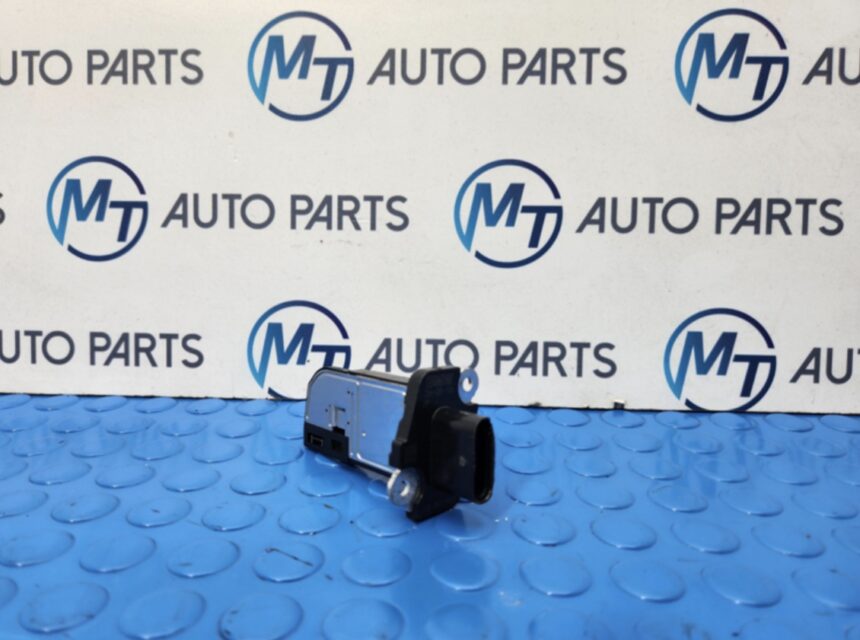
MAF stands for mass airflow. The sensor sits in the intake tract between the air filter housing and the throttle body. Every cubic metre of air your engine breathes passes through it. Its job is to measure the density and flow rate of that air, and feed the reading to the ECU in real time.
The ECU uses that figure to calculate how much fuel to inject. Get the air measurement wrong, and the fuel calculation is wrong, too rich, too lean, or oscillating between the two depending on how the sensor is failing. Everything downstream, idle quality, throttle response, fuel consumption, emissions, follows from that one measurement.
On BMW engines, the mass air flow sensor for BMW applications uses a hot-film element: a tiny heated wire or film suspended in the airstream. Incoming air cools it; the sensor measures how much current is needed to keep it at a set temperature. The colder and denser the air (more mass flowing), the more current required. It’s a precise measurement of what the engine is actually getting, not an estimate.
The Symptoms – What to Look and Feel For
Rough or hunting idle
This is one of the most common early signs on diesel BMWs, particularly anything running with the N47 engine, the 318d, 320d, 520d and their X3/X5 equivalents. At a standstill, the revs rise and fall slightly rather than sitting steady. It might be subtle enough that you only notice it when you’re parked up with the air conditioning on, or it might be pronounced enough to feel it through the steering wheel.
What’s happening is the ECU is receiving an inconsistent air mass reading and adjusting fuel delivery to compensate, which creates the oscillation. It’s trying to hold a stable idle and can’t get accurate enough data to do it.
Hesitation and flat spots under acceleration
The other classic presentation, and the one that tends to alarm people, is a hesitation or flat spot when you open the throttle. You pull out of a junction, the revs build, and then somewhere in the mid-range the engine seems to stumble or go momentarily flat before picking up again.
On petrol engines, the N55 in the 335i and 135i, or the N20 in the 320i and 520i, this often shows up as a brief cut-out feel under hard acceleration, or a reluctance to rev cleanly from low speeds. It’s a product of the ECU receiving a delayed or inaccurate MAF signal during a rapid change in throttle position.
Fuel economy getting noticeably worse
A gradual, unexplained rise in fuel consumption is one of the subtler symptoms, and one that tends to go unnoticed until someone mentions it in conversation or does the maths after a long run. If your BMW mass air flow sensor is reading low (reporting less air than is actually entering), the ECU will run the engine leaner than it should, which typically causes it to overcompensate elsewhere and burn more fuel overall.
On diesels with a DPF, a failing MAF also interferes with regeneration cycles. The filter never gets the clean burn it needs, and fuel economy drops for that reason too
Black smoke on startup or under load
Black smoke is unburnt fuel. It means the mixture is running rich. If your MAF is reading high (reporting more air than is actually entering), the ECU adds fuel to match, and you end up with excess that comes out of the exhaust. On diesels, this is most visible on a cold start or when pulling hard from low revs. On petrol engines, it might not be visible at all but will show up in emissions testing.
Hard starting
A BMW MAF sensor that has deteriorated significantly can cause difficulty on cold starts. The ECU needs accurate air mass data to calculate the correct fuelling for a cold, dense charge of air. If the reading is off from the moment the engine turns over, the initial fuelling is wrong and the engine can take several cranks to catch.
No warning light, and why that matters
Here’s the bit that catches people out. The fault codes associated with a failing BMW MAF sensor (P0100 through P0104), covering circuit range, performance, and signal faults, don’t always set when the sensor is simply contaminated or beginning to degrade. They typically set when the signal is completely absent or outside a defined range.
A sensor that’s reading 15% low across its entire operating range might not trigger a code at all. The ECU sees a plausible figure, doesn’t flag it as faulty, and continues adjusting fuel delivery based on bad data. You can drive for months with a contaminated BMW mass airflow sensor and a clean diagnostic readout. This is why live data is more useful than code reading alone when diagnosing intermittent running issues.
Why BMW MAF Sensors Fail
Contamination – the main culprit
The hot-film element at the heart of the sensor is extraordinarily sensitive. A thin film of oil or debris on the sensing element changes how air cools it, which changes the reading. The most common source of contamination on BMWs is crankcase vapour, oil mist from the engine’s breathing system that gets drawn back through the intake. Older N47 engines are particularly prone to this, especially once the breather valve or crankcase ventilation hose starts to deteriorate.
Pollen, fine dust, and carbon particles from EGR recirculation can also coat the element over time. The MAF sits in the path of everything the engine breathes, and not all of it is clean air.
Oiled aftermarket air filters
This one catches people who’ve fitted performance air filters. Aftermarket cotton gauze filters, the kind that need oiling, shed oil droplets into the intake if they’re over-oiled, and the hot-film element picks it straight up. Some brands are worse than others, but it’s a known issue with all oiled filter systems on any engine that uses a hot-film MAF. A dry paper OEM replacement doesn’t have this problem.
Intake air leaks
An unmetered air leak, a crack in the intake pipe between the MAF and the throttle body, a loose jubilee clip, or a split charge pipe, means the engine is drawing in air that the sensor never measured. The ECU calculates fuelling for the air that passed through the MAF, but the engine actually receives more. The result is a lean condition that can look identical to a failing sensor on a diagnostic scan. Always inspect the intake tract carefully before condemning the sensor.
The Fault Codes – and Why There Might Not Be Any
If you do have codes stored, the main MAF-related ones are:
MAF Sensor Fault Codes and What They Mean
- P0100 Mass Air Flow Circuit Malfunction – circuit open or shorted.
- P0101 Mass Air Flow Circuit Range/Performance – reading outside expected range.
- P0102 Mass Air Flow Circuit Low Input – signal too low. Check wiring and sensor.
- P0103 Mass Air Flow Circuit High Input – signal too high, check for unmetered air leaks.
- P0104 Mass Air Flow Circuit Intermittent – signal dropping in and out.
As noted above: none of these codes being present does not rule out a failing BMW MAF sensor. A live data log showing MAF values at idle and under load, compared against the expected figures for your engine code, tells you far more. A healthy MAF on a 2.0-litre BMW diesel should read roughly 2–4 g/s at idle; under hard acceleration, it should scale proportionally and respond immediately to throttle input. A degraded sensor will be sluggish, plateau early, or drift off the expected curve.
Cleaning vs Replacing
When cleaning is worth trying
If the sensor is contaminated but the element itself is intact, cleaning can restore function, and it costs about £10 and fifteen minutes. You need a dedicated MAF sensor cleaner spray, nothing else. Not brake cleaner, not carb cleaner, not contact spray. Those solvents attack the coating on the hot-film element and make things permanently worse. MAF cleaner is sold at most motor factors.
The process is simple: unplug the sensor, remove it from the intake (usually two screws or a simple clip on F and G generation), spray the element from about 10cm away, let it dry completely, at least 15 minutes, and refit. Don’t touch the element. Don’t shake it. Reassemble cold and see if it makes a difference before you commit to replacing.
When replacement is the right call
If cleaning doesn’t resolve the symptoms, or if the sensor has physical damage, it needs replacing. On newer BMWs, the OEM sensor is a Bosch hot-film unit, the same supplier BMW use from the factory, available as a standalone part rather than a full assembly. Fitted by a good independent, you’re looking at £80–180 for a new OEM Bosch sensor including labour.
Used BMW sensors are a legitimate alternative for cost-conscious owners, particularly for older F-generation cars where the cost of a new sensor approaches or exceeds the car’s annual service budget. MT Auto Parts stocks used genuine BMW mass airflow sensors for BMW 2012+ models, the same genuine units pulled from dismantled vehicles and listed with mileage and condition details so you can see exactly what you’re buying.
One important note: on G-generation vehicles, the ECU may need to be cleared, and the adaptation values reset after fitting any new or replacement MAF. Without that reset, the ECU continues operating on the old learned values and the symptoms may persist even with a good sensor in place. A basic diagnostic clear covers this.
Which BMW Models Are Most Affected
N47 diesel, the most common presentation
The 2.0-litre N47 diesel, used across the 1, 3 and 5 Series between roughly 2007 and 2015 (318d, 320d, 520d, 116d, 118d and their Touring and GT derivatives), is the engine most commonly associated with MAF sensor issues. The combination of EGR recirculation, a PCV system that moves oil mist through the intake, and the high number of these engines on UK roads means this combination, N47 engine, contaminated MAF, rough idle, hesitation at 1,500–2,000 rpm, is well known to anyone working on them regularly.
N55 and N20 petrol, hesitation under boost
The N55 turbocharged straight-six (335i, 535i, 135i, X5 35i) and the N20 turbocharged four-cylinder (320i, 520i, 328i and a range of X models) both use hot-film MAF sensors and are susceptible to the same contamination and intake-leak issues. On the N55 in particular, crankcase breather issues are a known weak point and can contribute to sensor contamination over time. Symptoms on these engines tend to present as hesitation under boost rather than idle problems.
G-generation B47 and B48: easier access, same sensor type
The current-generation B47 diesel and B48 petrol engines use the same hot-film sensor technology. Access is generally better on G-generation cars. The sensor sits upstream of the charge pipe and is accessible from above on most models. Failure modes and symptoms are identical to the older N-series engines; the difference is that you’re more likely to be dealing with a car that still has remaining warranty, making the case for a used part slightly less compelling unless the car is out of coverage.
Quick Reference – BMW MAF Sensor Symptoms
- Rough or hunting idle, especially on diesel at idle speed.
- Hesitation or flat spot under acceleration.
- Fuel economy getting noticeably worse without explanation.
- Black smoke on startup or under load (rich mixture).
- Hard cold starting.
- Check engine light with P0100–P0104 codes, OR no codes at all.
- Symptoms consistent but no fault codes stored. Use live MAF data.
Summary
The BMW MAF sensor is a small, inexpensive component relative to what it controls, but it sits at the centre of everything the engine does with air and fuel. When it starts to fail, the effects ripple through idle quality, throttle response, economy and emissions. And because it can degrade slowly, over months, without ever storing a fault code, it often flies under the radar longer than it should.
If your BMW is running slightly off and the usual suspects have come up clean, a live data check on the mass airflow sensor is a sensible next step. In many cases, a clean or a relatively modest replacement is all that’s needed to get things back to how they should be.
Disclaimer: This article is intended as general information only and does not constitute professional mechanical advice. Symptoms described may have multiple causes. Always have your vehicle diagnosed by a qualified technician before undertaking repairs. Fault code and live data interpretation require appropriate diagnostic equipment and expertise.