

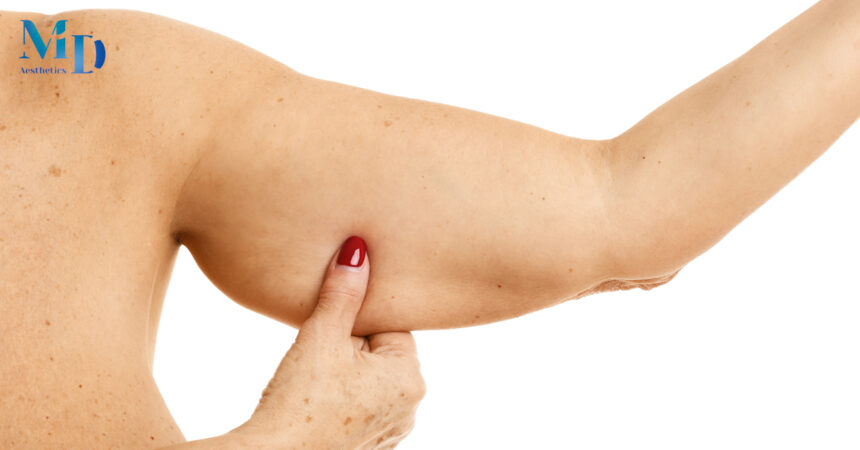
The upper arms can retain loose skin after major weight loss, even when muscle strength and overall fitness improve. For some individuals, excess tissue becomes noticeable when raising the arms, wearing fitted clothing or participating in physical activities. Patients considering arm lift in Turkey may benefit from understanding how brachioplasty removes redundant skin, how it differs from liposuction and why scar placement is an important part of surgical planning.
What Is an Arm Lift?
An arm lift, medically known as brachioplasty, is a procedure designed to remove excess skin and selected soft tissue from the upper arms.
The operation generally focuses on the region between the armpit and elbow.
The objective is to reduce hanging tissue and create a smoother upper arm contour.
Unlike treatments that primarily target fat, brachioplasty directly addresses skin redundancy.
This distinction is especially important for patients who have lost substantial amounts of weight.
Why Does Upper Arm Skin Become Loose?
Skin elasticity changes over time and differs between individuals.
When body weight increases, the skin stretches to accommodate additional tissue volume. After major weight loss, it may not contract sufficiently.
Age-related changes in collagen and elastin can also contribute to laxity.
Other influencing factors include genetics, sun exposure, smoking and repeated weight fluctuations.
Can Exercise Tighten Loose Arm Skin?
Resistance training can strengthen the biceps, triceps and surrounding muscles.
However, building muscle does not remove substantial excess skin.
Patients may therefore develop stronger arms while continuing to notice hanging tissue.
Surgery may be considered when the main concern is redundant skin rather than insufficient muscle tone.
Arm Lift Versus Arm Liposuction
Arm liposuction and brachioplasty address different tissue characteristics.
Liposuction reduces localized fat deposits through small incisions. It is generally more suitable when skin elasticity is sufficient to accommodate the reduction in volume.
An arm lift removes excess skin and may include limited fat removal when appropriate.
For patients with substantial laxity, liposuction alone can sometimes make the looseness more apparent.
A consultation should determine whether the problem involves fat, skin or both.
Different Arm Lift Techniques
The surgical technique depends on how much skin needs to be removed and where it is located.
Limited-Incision Arm Lift
Patients with relatively mild laxity concentrated near the armpit may be considered for a shorter-incision approach.
However, the amount of correction possible through a limited incision is restricted.
Traditional Brachioplasty
More extensive skin excess may require an incision extending along the upper arm.
The exact position is selected according to anatomy and surgical planning.
This approach can remove greater amounts of redundant tissue but produces a longer scar.
Extended Arm Lift
Following massive weight loss, loose skin may extend beyond the upper arm toward the side of the chest.
An extended procedure may be considered when correction of these connected areas is necessary.
Who May Be a Suitable Candidate?
Potential candidates generally have stable body weight, significant upper arm skin laxity and suitable overall health.
The surgeon evaluates tissue quality, medical history, previous weight changes and expectations.
Patients who are still losing substantial weight may be advised to wait until their weight stabilizes.
Smoking and certain medical conditions can increase the risk of wound-healing complications.
The patient should also understand the trade-off between improved contour and permanent scarring.
How Is Arm Lift Surgery Performed?
Brachioplasty is commonly performed under general anesthesia, although the approach depends on the extent of surgery and clinical circumstances.
The surgeon marks the planned areas of tissue removal before the operation.
Excess skin and selected soft tissue are removed, and the remaining tissues are repositioned.
The incisions are then closed with attention to minimizing excessive wound tension.
The procedure is tailored to the location of skin excess rather than using an identical incision pattern for every patient.
Recovery After Brachioplasty
Swelling, bruising, tenderness and temporary tightness are common during the early postoperative period.
Patients may need to limit lifting, pushing and pulling movements while the incisions heal.
Compression garments may be recommended according to the surgeon’s protocol.
Gentle movement is generally encouraged, but strenuous upper-body exercise requires medical clearance.
Returning to Daily Activities
The recovery timeline depends on the extent of surgery and the patient’s healing progress.
Activities that involve lifting heavy objects or repeatedly stretching the arms may need to be restricted for several weeks.
Patients should also arrange assistance with demanding household tasks during early recovery.
What Should Patients Know About Arm Lift Scars?
Scarring is one of the most important considerations in brachioplasty.
A traditional arm lift may leave a scar extending from the armpit toward the elbow.
The surgeon attempts to position the incision as discreetly as possible, but its visibility depends on arm position and individual healing.
Scars typically mature over many months.
Although their appearance may improve, they do not disappear completely.
Functional Benefits of Removing Excess Skin
Some patients seek brachioplasty primarily for aesthetic reasons, while others experience practical difficulties caused by hanging tissue.
Excess skin may contribute to:
- Friction during movement
- Discomfort in fitted sleeves
- Difficulty maintaining hygiene in skin folds
- Irritation during exercise
- A sensation of heaviness in the upper arms
Removing redundant tissue may improve these concerns, although outcomes vary.
Risks and Possible Complications
Potential risks include infection, bleeding, fluid accumulation, delayed wound healing, asymmetry and unfavorable scarring.
Temporary or persistent changes in sensation can also occur.
In some cases, wound tension may affect scar quality or require additional care.
A detailed medical evaluation and appropriate postoperative monitoring are important for reducing avoidable risks.
Arm Lift Surgery in Istanbul
International patients considering arm lift surgery in Istanbul should review the surgeon’s qualifications and experience with post-weight-loss contouring.
Travel arrangements should allow adequate time for postoperative examinations.
Patients should also consider how temporary arm movement restrictions may affect luggage handling, transportation and everyday activities after returning home.
Follow-up arrangements should be established before treatment.
Choosing Between Skin Removal and Fat Reduction
The decision to undergo an arm lift should begin with identifying the cause of the upper arm concern.
Liposuction may be appropriate for selected fat deposits, while brachioplasty is generally more effective for substantial loose skin. Some patients require a combination of techniques.
Individuals researching upper arm reshaping, scar placement and recovery can explore additional information at https://muratdiyarbakirlioglu.com/en/. An individualized assessment can help determine whether surgical skin removal offers a reasonable improvement and whether the expected benefits justify the permanent incision.