

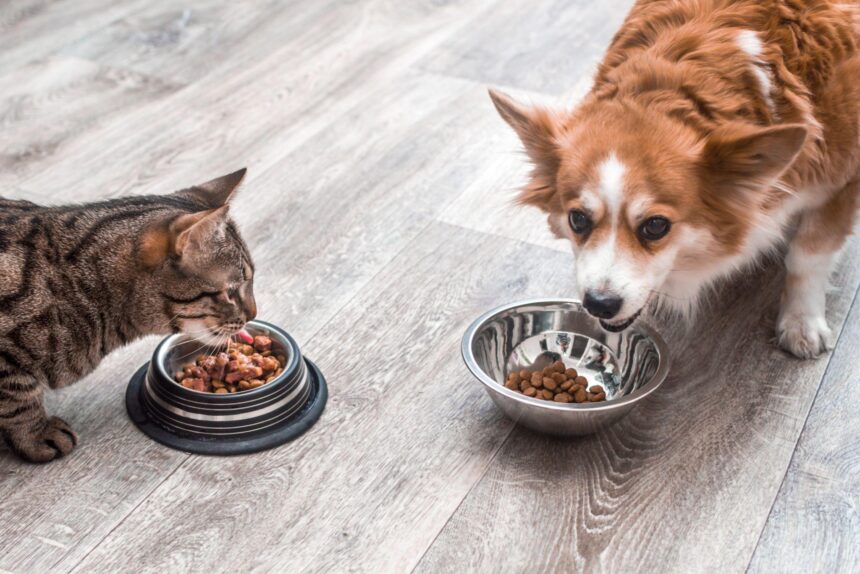
Stand in front of a pet food shelf and you will see the same words repeated across dozens of bags. Puppy, adult, senior. Mini, medium, maxi. Indoor, sensitive, light, sterilised. Then there are the breed-specific ranges, with a Labrador or a Maine Coon printed on the front. It can look like marketing, and some of it is. But the underlying idea is sound, and understanding it makes the choice far simpler.
A dog or cat’s nutritional needs are not fixed. They change with age, with body size, with activity and with health. Feeding one food to every animal for its whole life is a bit like feeding a toddler, a marathon runner and a grandparent the same meals. They would all survive, but none of them would do as well as they could.
Life stage is the first filter
Growing animals need more energy, more protein and a carefully balanced ratio of calcium and phosphorus to build bone. Too little stunts growth, too much in a large-breed puppy can cause joint problems that last a lifetime. That is why puppy and kitten foods exist as separate products rather than just a smaller kibble.
Adult food, often labelled maintenance, is formulated for an animal that has stopped growing and simply needs to hold its condition. Senior food, usually from around seven years in dogs and ten in cats, tends to have fewer calories, added joint support and adjusted phosphorus levels to go easier on ageing kidneys. The age cut-offs vary by brand and by size, so treat them as a guide rather than a rule.
Size and breed change more than the kibble shape
A Chihuahua and a Great Dane are the same species with wildly different bodies. Small dogs have fast metabolisms and tiny jaws, so their food is energy-dense and the kibble is small. Giant breeds grow for up to two years and are prone to hip and elbow problems, so their puppy food is deliberately less calorie-dense to slow growth to a safe pace.
Breed-specific ranges take this a step further. A manufacturer builds recipes around the known tendencies of a breed, so a Dachshund food supports the spine and a Persian cat food has a kibble shape suited to a flat face.
Royal Canin for dogs and cats also split by size, with Mini, Medium and Maxi lines for dogs and indoor, sterilised and kitten lines for cats. That means most owners can find a close match without going down to breed level at all.
Is breed-specific food necessary? For most healthy animals, no. A good size and life-stage match covers the majority of what matters. Breed formulas are useful where a breed has a well-documented weakness, such as skin issues in bulldogs or urinary problems in some cats, and the recipe addresses it directly.
Switching foods without upsetting the stomach
Whatever you choose, change over gradually. Mix a quarter of the new food with three quarters of the old for a couple of days, then half and half, then three quarters new, over about a week. Sudden changes are the most common cause of loose stools in otherwise healthy animals, and they get blamed on the new food when the real problem was the speed of the switch.
Give a new food at least a month before judging it. Coat condition, energy levels and stool quality are the signs to watch, and all three take weeks rather than days to respond. The same patience applies to most lifestyle changes people make for themselves, from sleep to exercise, and pets are no different in that respect.
The short version for a busy owner
Match the life stage first, then the size, then look at breed or health formulas only if there is a specific reason. Check the bag is labelled complete, look for a named protein near the top of the list, and weigh the portions. Also, don’t forget to buy from a reliable shop as Petworld.co.za. Do that and you have covered what matters for the vast majority of dogs and cats.
Everything beyond that is fine-tuning, and your vet is a better guide to it than the front of the bag.