

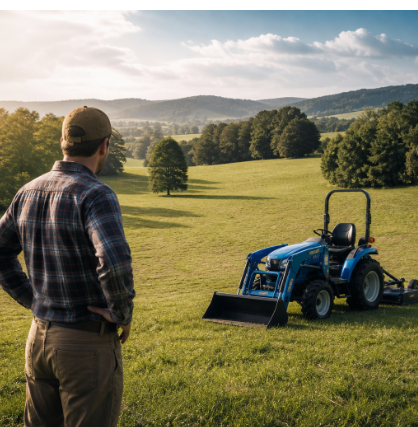
Most people who regret a tractor purchase did not buy the wrong brand. They bought the wrong size — usually too small for the loader work they actually do, or too heavy for the lawn they still have to cross twice a week. Getting the match right is less about horsepower bragging rights and more about an honest list of jobs, measured gates, and a sober look at what the implements will demand from the hydraulics. Here is a practical way to work through it, plus the maintenance and parts habits that keep a compact or utility machine earning its keep for a decade or more.
Start with the job list, not the spec sheet
Write down every task you expect the tractor to do in a year, then mark each one as weekly, seasonal or occasional. Mowing a paddock, moving round bales, grading a quarter-mile gravel drive, digging post holes, spreading manure, loading firewood, pulling a box blade after winter frost heave — these pull in different directions. Weekly jobs should set the machine’s size. Occasional jobs are candidates for rental, a neighbour’s gear or a custom operator.
Then measure the constraints nobody thinks about until delivery day: gate widths, barn door height with the loader mast raised, turning space between buildings, trailer capacity, and the steepest slope you will mow. A machine that cannot get through the gate to the back field is not a compromise, it is a mistake.
Rough size bands that hold up in practice
- Sub-compact: lawns, light grading, small gardens, tight orchards. Fine for a few acres and a mid-mount mower, but limited for loader work and bale handling.
- Compact: the sweet spot for roughly 5 to 25 acres. Enough weight and hydraulic flow for a loader, a rotary cutter and a backhoe, while still manoeuvrable around buildings.
- Utility: for hay ground, heavier tillage, large round bales and long drives. More mass, more lift, more fuel, and a bigger turning circle you will notice in a stockyard.
Weight, lift and traction matter more than peak horsepower
Loader work is governed by machine weight and rear ballast, not engine output. A light tractor with an impressive lift rating will lighten its back wheels the moment you curl a full bucket of wet gravel. Ask for the loader’s lift capacity at the pins and at full height, then compare it with the weight of what you actually lift — a round bale of dry hay and a soaked one are very different propositions. Plan ballast from the start: a filled rear tyre, a ballast box, or an implement left on the three-point hitch.
Check the PTO horsepower rather than the gross engine figure, because that is what a rotary cutter, mower conditioner or baler sees. Confirm hydraulic flow and the number of remote valves if you want a grapple, a hydraulic top link or a loader-mounted bale spear later. Retrofitting a second remote is routine; discovering you needed one mid-hay season is not.
Packages versus piecemeal buying
Bundled tractor packages — typically a tractor, loader, rotary cutter or box blade, and a trailer rated for the lot — solve the matching problem for you. The implements are sized to the machine, the hitch categories agree, and the trailer actually carries the combination legally. Buying piecemeal gives you more freedom and lets you hunt for used implements, but it puts the burden of compatibility on you: hitch category, PTO shaft length, driveline shielding, mower deck width versus rear tyre track. If you are new to tractors, a matched package is usually the faster route to a working outfit; if you already own good implements, build around them instead.
Own it or hire it? Run the numbers first
Before buying a baler, rake and mower conditioner to cut 15 acres of grass hay, price the alternative. Custom operators charge by the acre or the bale, and the published figures are easier to find than most owners expect — regional surveys such as the 2026 custom rate survey from AgriLife give a reasonable reference point for baling, mowing and tillage rates when you are testing whether ownership pays. Compare that against depreciation, storage, twine or net wrap, repairs and your own labour. Hay equipment in particular has a brutal ratio of annual hours to purchase cost unless you are doing real volume or your weather windows are too short to wait on someone else’s schedule.
Parts, service and the case for genuine components
A tractor is only as reliable as the parts channel behind it. Filters, belts, blades, hydraulic hoses, baler teeth and mower spindles are consumables, and the cost of a cheap substitute shows up as downtime in the one week you cannot afford it. Genuine parts matter most where tolerances and materials are doing real work: fuel and hydraulic filtration, emissions-related components, driveline parts and anything that affects a warranty claim. For wear items like mower blades or lights, aftermarket is often sensible. The practical answer for most owners is a relationship with a tractor parts dealer who can supply genuine Kubota parts alongside general tractor, mower and baler components, and who also has a service department when a job is beyond the farm shop — H&R Agri Power, for example, is an authorized Kubota dealer selling new and used tractors and implements with parts and repair service at its Kentucky, Tennessee and Indiana locations, including lawn mower repair in Owensboro, Kentucky. Give them your model and serial number once and keep it in your phone; it saves a call every time.
A seasonal service rhythm that actually gets followed
Spring
- Change engine oil and filter, check hydraulic and transmission fluid levels, and replace fuel filters before heavy use.
- Grease every zerk on the loader, three-point and driveline — most owners miss the driveshaft cross journals.
- Inspect tyres for sidewall cracking and set pressures for the work ahead, not last autumn’s.
Haying and mowing season
- Blow out radiator screens and air filters daily in dusty or chaffy conditions.
- Carry spare belts, net wrap or twine, blades, shear bolts and a hose repair kit — not because failure is likely, but because it is predictable.
- Check baler pickup teeth, bearings and chain tension between fields rather than at the end of the day.
Autumn and winter
- Treat and top off diesel to limit condensation, and keep the battery on a maintainer if the tractor sits.
- Pressure wash implements, touch up bare metal, and store cutter decks on blocks off wet ground.
- Book bigger repairs in the off-season, when the service department is not three weeks deep in harvest work.
The small logistics that make long days bearable
Equipment planning gets all the attention, but the human side of a 14-hour baling day decides whether the last load goes in the barn or gets rained on. Fuel and water on the trailer, a shade spot for the crew, and food that survives a cooler all count. Plenty of operators swear by something cold and starchy at midday rather than a heavy hot meal — a chilled rice salad travels well in a cool box and keeps people moving, and if you would rather buy than cook, local guides to where to find a decent ensalada de arroz nearby are worth bookmarking before the season starts.
Before you sign anything
Walk the property with a tape measure, list the weekly jobs, and pick the smallest machine that does those comfortably with correct ballast. Confirm hydraulic remotes and PTO power against the implements you intend to run, not the ones you already own. Ask where parts come from and how service calls are scheduled before you ask about the colour of the paint. A tractor bought that way tends to be the one still working when the finance paperwork is long forgotten.