

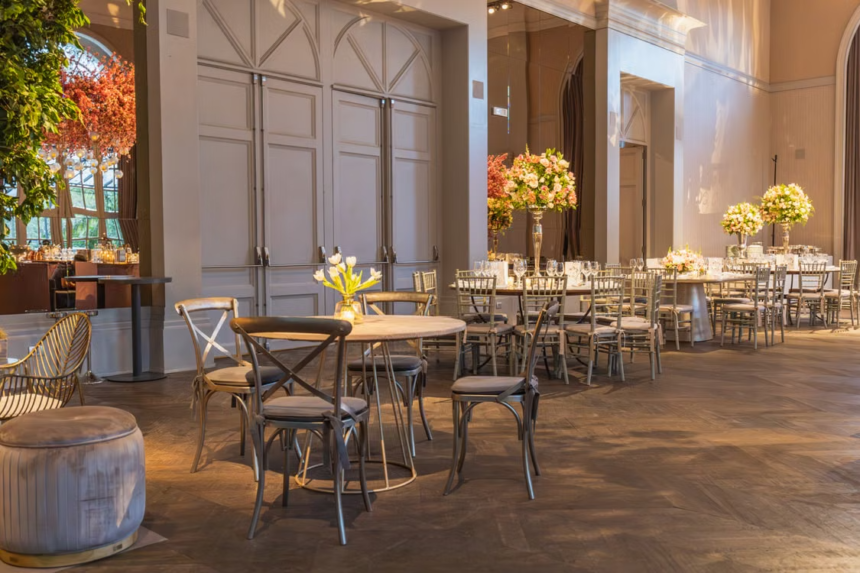
A hotel function room hosts a breakfast seminar on Friday, a wedding reception on Saturday and a charity dinner on Sunday.
The room stays the same, but almost everything else changes. The number of guests, the layout, the atmosphere and the time available for setting up can all be different.
For venue teams, seating is often where those differences become difficult to manage. Chairs that look right at a wedding may take too long to move before a conference. Lightweight options may be easy to handle but uncomfortable during a three-course dinner. Buying a different set for every occasion, meanwhile, can quickly fill the storeroom and tie up money in furniture that spends much of the year unused.
The practical answer is not to find a chair for every possible event. It is to choose a core seating collection that can adapt to the way the venue actually operates.
Start with the changeover, not the photograph
It is natural to judge event seating by appearance. Clients do the same when they browse venue photographs. Yet a chair has a working life that begins well before guests enter the room. It must be unloaded or taken out of storage, carried into position, aligned, dressed if necessary and removed again after the event.
For a multipurpose venue, well-chosen banquet chairs can provide the useful middle ground between appearance and everyday practicality. A consistent design may be used around round tables for a reception, placed in straight rows for a presentation and rearranged into smaller groups for a workshop. The room changes character without the venue having to replace its entire seating stock.
Imagine a 120-person room that hosts a business conference in the morning and a private dinner that evening. A chair that is stackable and straightforward to handle allows staff to clear rows, bring in dining tables and reset the space efficiently. That matters when the gap between bookings is measured in hours rather than days.
Stackability should still be checked properly before buying. Ask how many chairs can be placed in one stack, whether a suitable trolley is available and how much room the stacked units occupy. Measure doorways, lifts and storage areas too. A model may stack neatly in a showroom but still be awkward to move through a venue’s narrow service corridor.
Let one chair take on three different roles
The first test could be a daytime conference. Guests may remain seated for several sessions, so stability and support matter more than decorative detail. Chairs need to sit evenly in rows, leave sensible aisles and allow staff to create a clear layout without constant adjustment. Dark or neutral finishes often work well with presentation equipment and business signage.
For a wedding, the same chair has a different job. It becomes part of the visual setting alongside table linen, flowers and lighting. A simple, well-proportioned frame is often easier to style than an elaborate design. Seat pads, selected covers or subtle decorations can alter the look without making every wedding feel identical. It is also worth checking whether any added fabric or ties interfere with stacking or slow down the turnaround.
At an awards dinner or community fundraiser, comfort moves higher up the list. Guests could be seated through a meal, speeches and entertainment, so the seat needs to remain supportive for several hours. This is where a sample chair is valuable. Sit in it for longer than a few minutes, try it at the tables used by the venue and check whether guests can move their legs without striking the table base.
Flexibility also depends on colour. A restrained finish can support corporate branding one day and warmer wedding styling the next. Black, gold, silver, clear and pale neutral options each create a different mood, but the best choice is the one that works with the room’s existing flooring, walls and lighting. A chair should not force the rest of the venue to compete with it.
Count the hidden costs as well as the chairs
The purchase price is only one part of event seating costs. Staff time, storage, cleaning, repairs and replacement all affect what a chair costs over its useful life. A cheaper model that marks easily or requires two people to move may become the more expensive choice after a busy season.
Start by calculating realistic capacity rather than simply ordering enough seats for the venue’s maximum number. Include a small reserve for damage, last-minute guest changes and maintenance. The exact allowance will depend on how frequently the venue is used and how quickly replacement stock can be obtained. Keeping too few spares can create a crisis before an event, while keeping far too many consumes valuable storage space.
Materials should suit the venue’s routine. Frames need to tolerate frequent movement, while upholstery or seat pads should be manageable when spills occur. Check how the feet meet the floor, particularly on timber, tile or polished surfaces. Replaceable glides and removable cushions can make routine upkeep easier and may extend the useful life of the collection.
Commercial buyers should also ask practical questions before placing a large order. Can a sample be viewed or supplied? Do the chairs arrive assembled? Are individual replacements likely to remain available? What are the delivery arrangements for a large quantity? Seats & Beyond, for example, works with venues, hotels, restaurants, event planners and hire companies, offers nationwide UK delivery and allows buyers to arrange a warehouse viewing or request a sample for evaluation.
Finally, run a trial layout with the venue’s own tables. Dimensions on a product page cannot show whether service staff have enough room to pass, whether chair backs collide or whether the planned capacity leaves suitable routes through the space. A short test can prevent a costly mismatch.
A room that is ready for what comes next
Versatile seating does more than change the appearance of a function room. It shortens changeovers, makes storage easier and gives the events team more freedom when a client asks for a different layout. That flexibility can help a single space accommodate a wider mix of bookings without making every event look the same.
The strongest choice will usually balance four things: comfort for the guest, durability for regular commercial use, manageable storage and a design that can be restyled. None should be judged on its own. A beautiful chair that is difficult to move creates work behind the scenes, while a practical chair that feels uncomfortable soon becomes part of the guest experience for the wrong reason.
Before committing to a full order, create the three layouts the venue uses most often and compare suitable models against each one. Check the dimensions, request a sample where possible and involve the staff who will handle the chairs every week. The right seating should not merely suit the next event. It should make preparing for the event after that noticeably easier.