

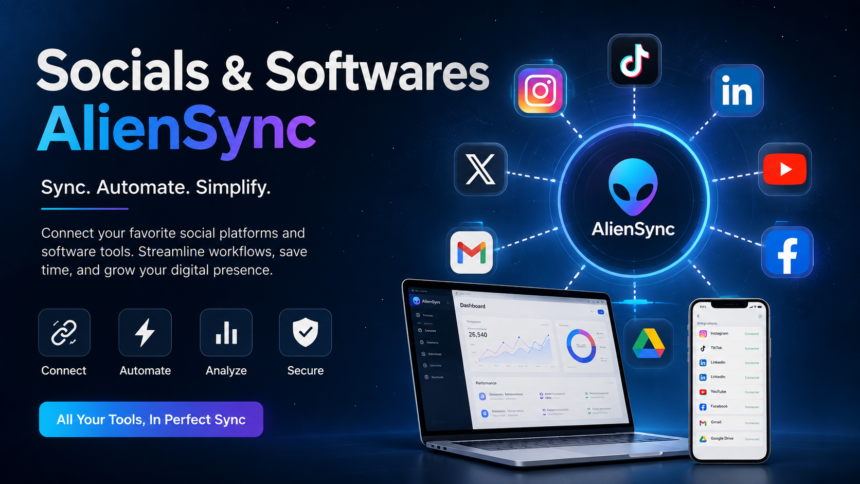
The phrase socials and softwares AlienSync has become increasingly visible in technology searches, but its meaning is not immediately obvious. Some pages describe AlienSync as a way to connect social media accounts with software, while others make it sound like a complete social-management application.
The available evidence requires a more careful explanation.
As of August 2026, AlienSync is best understood as a technology-focused editorial brand combined with a conceptual framework for synchronizing social platforms, apps, content, and business workflows. AlienSync’s own published material acknowledges that it does not currently have verified public APIs or SDKs associated with a conventional downloadable software product.
This does not make the idea behind AlienSync irrelevant. Connecting social platforms with other software is a genuine and useful area of technology. Major platforms including TikTok, Instagram, LinkedIn, X, and Google provide APIs and authorization systems that can support these kinds of connected workflows.
The important point is knowing the difference between what AlienSync represents as a concept and what has been independently verified as a working product.
What Is AlienSync?
AlienSync describes itself as a technology destination covering areas such as software, social platforms, blockchain, crypto applications, and digital innovation. Its About page focuses heavily on its role as an editorial platform publishing technology content.
More recent AlienSync material describes socials and software AlienSync as a synchronization-focused ecosystem or framework. In simple terms, the idea is that information from one digital service could trigger an action or update somewhere else.
For example, a company might want a new product entered into its internal system to appear in its marketing workflow automatically. A marketing team could then prepare an approved social post without manually transferring the same information between several applications.
The concept therefore centers on reducing disconnected work between social media and business software.
Importantly, AlienSync’s own material says there are currently no verified public APIs or SDKs for the framework. An independent 2026 review similarly found no clearly established developer platform, public integration directory, pricing structure, or conventional SaaS offering that verifies every feature sometimes attributed to AlienSync online.
For that reason, AlienSync is more accurately discussed as a technology concept and editorial ecosystem rather than assumed to be a mature social-media management application.
Why Synchronization Matters
Modern businesses rarely operate through one piece of software.
A marketing team may use social networks for publishing, cloud storage for images, project-management software for approvals, analytics platforms for reporting, and customer-management systems for leads. Moving information manually between those services can become repetitive.
Synchronization attempts to reduce that problem.
Instead of copying the same information several times, software integrations allow an authorized application to exchange selected data with another platform. The process can include scheduled actions, event-based triggers, notifications, content transfers, or reporting.
This basic principle behind socials and softwares AlienSync reflects genuine integration practices already found across established platforms.
TikTok, for example, provides a Content Posting API through which approved applications can allow authorized creators to publish content. TikTok requires applications to be registered, appropriate permissions to be approved, and users to authorize the relevant publishing scope.
Instagram also provides publishing capabilities for professional accounts through its API environment, subject to access tokens and required permissions.
So while AlienSync itself should not be confused with these verified platform APIs, the broader synchronization model is technically realistic.
How It Could Work
A useful way to understand an AlienSync-style workflow is to think about sources, rules, permissions, and destinations.
The source is where an event begins. It could be a newly approved campaign, a new piece of content, a customer update, or a product status change.
A rule determines what should happen next. For example, when a campaign reaches an approved status, its media could be moved to a publishing queue.
The destination is the service receiving the information. That could be a social network, analytics system, collaboration platform, CRM, or another application.
Permissions sit between these steps.
Modern integrations generally cannot simply enter a user’s account and perform actions without authorization. Platforms provide developer APIs and permission systems that control which resources an external application may access.
That principle is central to legitimate software synchronization.
Social Connections
Social networks differ considerably in what outside software is allowed to do.
TikTok’s official developer documentation supports direct content posting for approved integrations. Applications require appropriate access and authorization, and TikTok places restrictions on unaudited clients during testing.
Instagram’s API allows eligible professional accounts to work with publishing and management functionality when the application has the necessary access token and permissions.
LinkedIn uses OAuth 2.0 for member authorization and API authentication. A member must authorize an application before that application can access permitted member resources.
X also provides authentication options including OAuth 1.0a and OAuth 2.0, with user-context authorization used when applications need to perform permitted actions on behalf of an account.
These examples show why claims that one application “connects everything” should always be examined carefully. Every social network has its own APIs, permission rules, review procedures, access limits, and platform policies.
An integration must work within those requirements.
Software Connections
Social platforms are only one side of synchronization.
A connected workflow can also involve productivity tools, cloud storage, analytics, email, databases, and customer-management software.
Google Workspace provides a useful example. Applications accessing Workspace APIs generally need proper authentication and authorization. When user information is involved, users may be shown a consent screen explaining what the application wants to access.
Google also divides access into specific OAuth scopes. A scope determines what an application can see or do.
Some scopes may only permit access to particular files, while broader scopes can grant significantly greater access. Google’s own guidance recommends choosing the narrowest permissions necessary rather than requesting access an application does not actually need.
This is an important consideration for any AlienSync-style system. Connecting several applications can make work more convenient, but it also creates more places where permissions and data flows must be controlled.
Practical Uses
The strongest use case for the AlienSync idea is workflow coordination rather than simply posting the same message everywhere.
Consider an online retailer preparing a product launch. Product information may begin in an inventory system. Images may be stored separately. Marketing copy may require approval from another team.
A synchronized workflow could move an approved asset into a social publishing process only after the necessary checks are complete.
An agency could use a similar structure. Instead of passing files through long email chains, its project-management system could mark content as approved, allowing another connected service to prepare it for publication.
Customer-facing teams could also connect social activity with internal software. A qualified response from a social campaign could be passed to the appropriate customer-management workflow rather than being copied manually.
These examples demonstrate the value of controlled automation: reducing repetitive actions without removing human oversight where decisions still matter.
Main Benefits
The most obvious benefit of synchronization is less repetitive work.
When employees repeatedly copy names, files, campaign details, or other information from one system into another, both time and accuracy can suffer. A carefully designed integration can automate predictable transfers.
Consistency is another advantage.
When several systems receive information from an agreed source, there is less risk that one employee publishes an outdated version while another team works from the current version.
Centralized workflows can also make accountability clearer. Teams can establish who approves an action, what happens after approval, and which system holds the original information.
For social-media work in particular, this can help organizations coordinate content, approval, publishing, and reporting without treating each channel as a completely separate process.
Important Limits
Synchronization is not the same as unlimited access.
A social network may allow one type of post through its API while restricting another. Different account types may have different capabilities. Applications can also require reviews before receiving sensitive permissions.
For example, TikTok requires approval and user authorization for its publishing scope, while unaudited clients face posting restrictions.
Instagram publishing also comes with account, authentication, and permission requirements.
API conditions can change over time as well.
That means any platform claiming integrations with several major social networks should provide current technical documentation showing exactly which actions are supported.
This is particularly important with AlienSync because its current public materials contain different descriptions of what the name represents. Some pages discuss product-like features, while another official AlienSync explanation explicitly characterizes it as an editorial brand and conceptual synchronization framework without verified public APIs or SDKs.
Readers should therefore distinguish proposed capabilities from demonstrated ones.
Security Matters
Connecting accounts is convenient only when access is handled responsibly.
One important technology here is OAuth. The OAuth 2.0 framework was designed to let a third-party application receive limited access to a service without requiring the resource owner to hand over their account password directly.
Permissions still need careful attention.
If a tool only needs to read a certain piece of information, giving it permission to modify or delete unrelated information creates unnecessary risk.
Google specifically recommends choosing the most narrowly focused authorization scope available. Sensitive and restricted scopes can also require additional verification because of the level of access involved.
Users evaluating any synchronization service should therefore check what permissions it requests, why those permissions are needed, how access can be revoked, and what happens to stored information after an account is disconnected.
Is AlienSync Safe?
There is currently not enough public evidence to give AlienSync the same level of technical verification that can be given to an established platform with public developer documentation, compliance information, and a transparent integration directory.
AlienSync itself acknowledges this uncertainty in a recent safety article, describing its security position as potentially safe but not yet proven, while encouraging users to verify security claims instead of relying on marketing descriptions.
Its public privacy policy discusses website-related collection such as IP addresses, browser information, cookies, visit information, and advertising technologies. The policy is principally written around visitors to the AlienSync website.
That is different from detailed documentation explaining the handling of credentials, social-account tokens, business records, or other information inside a mature synchronization product.
Anyone considering connecting important business or social accounts to an unfamiliar platform should therefore verify the exact service, developer documentation, permissions, security policies, company information, and account-revocation process first.
Do not provide account passwords simply because a website says it can connect to a social platform. Legitimate API integrations commonly use controlled authorization processes rather than asking a third party to store the user’s social-network password.
Before Using It
Start with verification.
Check whether the service has current documentation for each claimed integration. A simple logo showing Instagram, TikTok, LinkedIn, Google, or X is not evidence that an integration is officially available.
Look for a clear explanation of requested permissions.
If a service wants access to content publishing, account information, cloud files, or messages, it should explain why each permission is required.
Review how access can be removed. Established platforms generally provide ways to revoke authorized applications or tokens.
Businesses should also test unfamiliar integrations using non-critical accounts and limited data before introducing them into important workflows.
Finally, maintain human approval for consequential actions. Automation is most useful when repetitive steps are automated while important decisions remain properly reviewed.
Who May Benefit?
The ideas represented by socials and softwares AlienSync are most relevant to people who regularly move information between several online services.
Content teams may benefit from coordinating creative assets and publication workflows.
Marketing agencies may use synchronization principles to organize multiple client campaigns and approval processes.
E-commerce businesses can connect product updates with marketing activity.
Customer-support and sales teams can benefit when qualified social interactions are routed into appropriate internal systems.
Developers and operations teams may use similar patterns to build event-driven integrations between applications.
In each case, the real value comes from designing a reliable workflow—not from connecting services simply because a connection is technically possible.
The Bigger Picture
The interest surrounding socials and softwares AlienSync reflects a genuine problem in modern digital work: people use many different platforms that do not naturally behave like one system.
Integration technology can reduce that fragmentation.
Official APIs from platforms such as TikTok, Instagram, LinkedIn, X, and Google demonstrate that controlled sharing between applications is already a practical part of the modern software environment.
AlienSync’s current public identity, however, should be represented accurately.
Based on available information in August 2026, AlienSync is primarily an editorial technology brand and synchronization concept rather than a clearly verified, fully documented SaaS product. Its concepts can still help readers understand how connected social and software workflows might operate, but individual integration claims should be checked against official technical documentation before they are treated as available features.
That distinction gives users something more useful than promotional promises: a realistic framework for understanding what social-software synchronization can do, how legitimate integrations operate, and what should be verified before trusting them with real accounts or data.
FAQs
What does socials and softwares AlienSync mean?
The phrase generally refers to AlienSync’s coverage and conceptual framework for connecting social platforms with applications, software, content, and digital workflows. Current evidence suggests AlienSync is primarily an editorial and conceptual platform rather than a clearly documented standalone synchronization product.
Is AlienSync a real software application?
AlienSync has a functioning website and publishes technology content, but public information does not currently establish it as a conventional SaaS product with verified public SDKs, APIs, pricing, and a complete developer integration directory. Some AlienSync articles describe software-like capabilities, so readers should verify specific claims before relying on them.
Can AlienSync connect social media accounts?
Various AlienSync pages discuss connections with social platforms, but public technical documentation confirming every claimed integration is limited. An integration should not be considered verified merely because a platform is mentioned in an article.
Can social media really be connected to other software?
Yes. Social-software integration is a genuine technology model. TikTok, Instagram, LinkedIn, X, and other platforms provide APIs and authorization systems that allow approved applications to perform specific permitted actions.
How does social and software synchronization work?
Typically, an application receives permission to access specific resources through an API. An event in one system can then trigger a predefined action in another. The exact capabilities depend on the API, permissions, account type, and rules of each platform.
What is OAuth and why is it important?
OAuth is an authorization framework that allows third-party applications to receive controlled access to services without requiring users to directly share their passwords with those applications. The access granted can be limited according to defined permissions.
Is it safe to connect social accounts to third-party software?
It can be, provided the software is trustworthy and uses properly implemented authorization and security controls. Users should review requested permissions, privacy policies, developer documentation, security practices, and methods for revoking access before connecting important accounts.
What permissions should an integration request?
A service should generally request only the permissions required for its stated function. Google’s OAuth guidance, for example, recommends selecting the most narrowly focused scopes possible rather than requesting unnecessary access.
Who can benefit from synchronized social and software workflows?
Marketing teams, agencies, e-commerce businesses, content creators, customer-support teams, developers, and organizations managing several digital tools may benefit by reducing repetitive data entry and improving workflow consistency.
Does AlienSync have public pricing?
As of August 2026, available research does not show a clearly established SaaS pricing structure connected to a verified standalone AlienSync software platform. Readers should check current official information before making purchasing decisions.
What should I check before using AlienSync or a similar service?
Verify its official developer documentation, supported integrations, requested OAuth permissions, privacy policy, security information, pricing, account-revocation options, and support details. For unfamiliar services, testing with a non-critical account is also sensible.
Is AlienSync the same as a social media scheduler?
Not based on the clearest current evidence. While some AlienSync content describes capabilities resembling scheduling and automation software, AlienSync’s own material also identifies it as an editorial brand and conceptual framework. It is therefore better to avoid describing it as a conventional social-media scheduler unless verifiable product documentation becomes available.
Read also BTWRadiovent Event by BetterThisWorld: A Complete Guide