

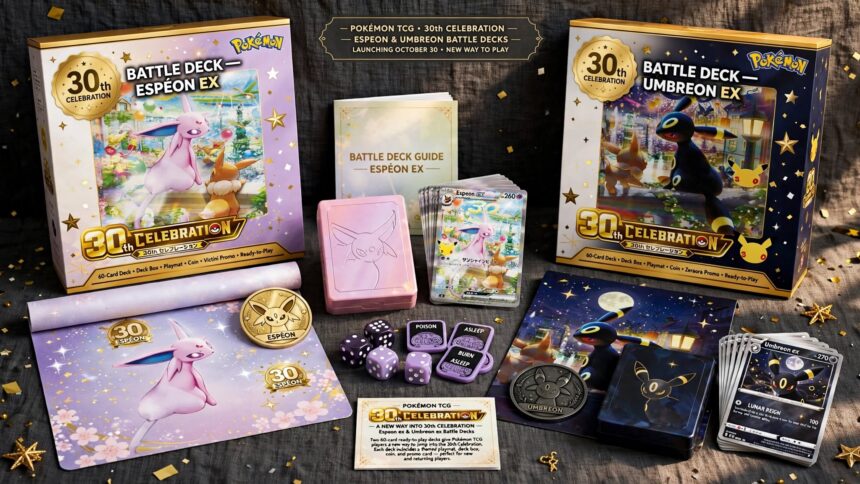
Pokémon TCG: 30th Celebration has already brought anniversary cards, Classic Collection reprints and 30 different Pikachu illustrations to collectors. The next release arrives on 30 October, when Espeon ex and Umbreon ex Battle Decks join the expansion’s growing product line.
The timing is useful for players who enjoy the visual appeal of 30th Celebration but want something they can take straight to a kitchen-table match or Pokémon League. Booster packs are built around discovery, while the two Battle Decks provide fixed card lists and a clear starting point for play.
Opening packs still has an element of surprise, much like chance-based entertainment at BetTOM casino, but Pokémon cards have a different purpose once they leave the pack. They can be collected, traded, protected in a binder or added to a playable deck.
The Espeon ex and Umbreon ex products arrive as the final October release for the 30th Celebration expansion. Each deck contains 60 foil cards, alongside the practical items needed for a game, including a deck box, playmat and coin. That matters because a new collector does not have to assemble a legal list card by card before learning the basics.
Why the new Battle Decks matter
Battle Decks are designed to reduce the barrier between buying cards and playing the game. A booster bundle can add exciting pulls to a collection, but it rarely provides the balanced spread of Pokémon, Trainers and Energy cards needed for a proper deck.
A fixed deck gives players a chance to understand the rhythm of a match. They can set up Basic Pokémon, evolve where possible, attach Energy, play Trainer cards and take Prize cards without first studying hundreds of possible combinations.
Espeon ex and Umbreon ex also make sense as headline choices for an anniversary range. Both Pokémon have long been popular with collectors, and their contrasting designs give the products a clear identity. Espeon’s bright, psychic look and Umbreon’s darker colour palette provide a natural choice for players who prefer one style over the other.
The decks are not aimed only at complete beginners. They can also suit parents buying for children, returning players who want a quick match, or collectors who prefer a product with a guaranteed set of foil cards instead of relying on booster packs.
A different kind of 30th Celebration product
The 30th Celebration expansion launched in September to mark three decades of the Pokémon Trading Card Game. It contains more than 150 cards, including 30 Pikachu rare cards with different illustrations, over 20 illustration rare and special illustration rare cards, two Futuristic rare cards, and a Classic Collection built around well-known cards from earlier eras.
That scale makes the expansion attractive to collectors, but it can be difficult to know where to begin. Some players will focus on completing a Pikachu page in a binder. Others may search for the Classic Collection cards that connect with their earliest memories of Pokémon.
The Battle Decks offer a more direct route. They do not replace the chase for rare cards, but they give the expansion a practical side. A player can open their deck, read through the card text and start learning how its central Pokémon works without waiting for the right pulls.
This also makes the decks useful for two people starting together. Buying one Espeon deck and one Umbreon deck creates an immediate match-up, with both players working from products made for the same entry level.
Espeon ex or Umbreon ex?
The choice will partly come down to which Pokémon a player likes more, but the two products can also appeal to different types of collector.
Espeon has usually been associated with a cleaner, brighter visual style. Its cards tend to attract fans of Psychic-type Pokémon and people who prefer the daytime identity of the 30th Celebration set. Umbreon has the opposite appeal. Its dark colouring and night-time image have made it one of the most collected Eeveelutions, especially among players who enjoy the more atmospheric side of Pokémon artwork.
For somebody building a display collection, the decision may be as simple as choosing the Pokémon that fits their binder page. For players, the more useful approach is to read the deck list once it is available and see how each product handles Energy, switching, drawing cards and damage.
Battle Decks are built for accessibility, so neither should be treated as an automatic route into high-level tournament play. Their strength lies in helping players understand the game’s mechanics and giving them a complete deck for casual matches.
The best way to use a Battle Deck
A first game is easier when players focus on the basic turn structure rather than trying to memorise every card effect. Start by laying out the playmat, shuffle the deck, set aside six Prize cards and choose a Basic Pokémon for the Active Spot.
The early turns usually involve building a Bench and attaching Energy. Players then decide when to use Trainer cards, when to evolve Pokémon and when to attack. Each knockout earns a Prize card, and the player who takes all six wins.
Because both new products are ready-made decks, they are well suited to repeated games. Players can learn which cards they want in their opening hand, when an Energy attachment matters most and how a switch or Supporter card can alter a difficult turn.
After a few matches, it becomes easier to see where personal changes might help. That could mean adding cards from a collection, trying another deck, or moving into a more advanced League Battle Deck later on.
A late-October release with practical appeal
The 30 October Battle Decks close a busy month for the Pokémon TCG. They offer something different from the main appeal of anniversary booster packs: a dependable way to play with cards from the current celebration.
Collectors still have plenty to look for across the expansion, particularly the Pikachu rares and Classic Collection cards. Players, meanwhile, will have two accessible options that turn the anniversary set into an actual game night.
Espeon ex and Umbreon ex are familiar Pokémon, but the value of these products lies in their simplicity. Open the box, choose a deck, find an opponent and start playing.