
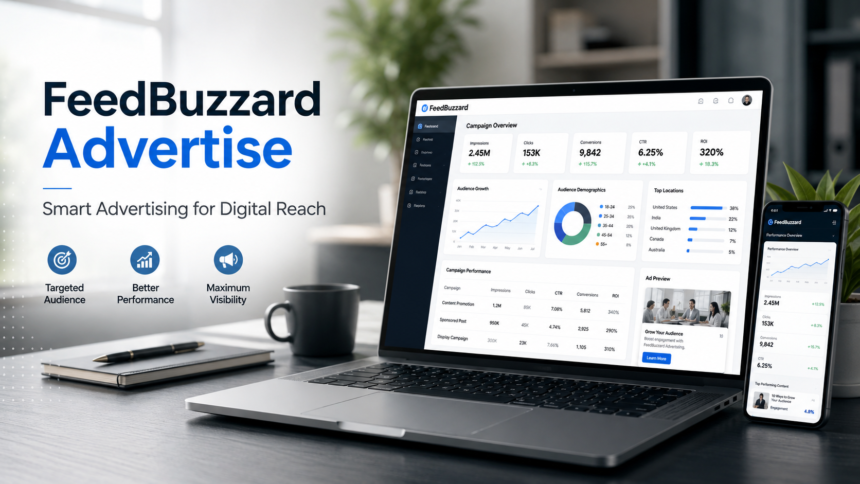
Advertising on smaller, content-focused websites can give businesses another way to reach readers outside large platforms such as Google, Facebook, and Instagram. That is one reason searches for FeedBuzzard Advertise have attracted attention among website owners, marketers, publishers, and growing brands.
FeedBuzzard is primarily presented as a content website covering areas such as technology, business, gaming, cryptocurrency, coding, and digital trends. Its own website also publishes information related to advertising and partnerships.
However, businesses should approach advertising opportunities carefully. Before paying for a placement, the advertiser should understand the audience, available formats, expected visibility, reporting methods, pricing terms, and whether the campaign matches its marketing goals.
This guide explains what FeedBuzzard advertising means, how businesses can approach it, what to check before spending money, and how to measure whether a campaign is actually worthwhile.
What Is FeedBuzzard?
FeedBuzzard is an online publishing website offering articles across several digital and general-interest topics. Its current content includes technology, business, gaming, financial topics, cryptocurrency, coding, and other web-focused subjects.
Its public About information describes a publishing workflow involving writers, editors, source checking, SEO review, publication, and later content updates. The website also provides contact options for feedback, partnerships, and relevant business inquiries.
For advertisers, that matters because FeedBuzzard should be viewed first as a publisher and content website. Advertising on a publisher works differently from running an automatic campaign through a large self-service platform.
Instead of assuming that every advertising feature mentioned in third-party articles is available, businesses should confirm current opportunities directly with FeedBuzzard.
What Does FeedBuzzard Advertise Mean?
The phrase FeedBuzzard Advertise generally refers to promoting a business, product, service, website, or piece of content through FeedBuzzard.
FeedBuzzard itself has published advertising-related guides discussing campaign objectives, audiences, creative formats, budgets, targeting, and measurement. The site also advises advertising inquiries to request information such as a media kit or rate card and provide campaign dates, audience requirements, and a proposed budget.
The exact advertising arrangement available to a business may vary.
For that reason, marketers should avoid assuming that a certain ad format, targeting method, price, traffic volume, or performance level is guaranteed until it has been confirmed directly.
A professional advertising inquiry should establish exactly what the advertiser is buying and how its performance will be measured.
Why Brands Consider FeedBuzzard
One advantage of advertising on a content website is context.
Someone reading an article about technology, software, business, gaming, or another specialized subject already has an interest in that topic. A relevant advertisement placed alongside suitable content may therefore feel more natural than an unrelated promotion appearing randomly elsewhere.
For example, a software company may be more interested in visitors reading technology or coding articles, while a business service could fit more naturally around entrepreneurship or business content.
This does not automatically guarantee conversions. It simply gives advertisers an opportunity to match their message with relevant editorial environments.
Another attraction is diversification.
Businesses that depend completely on one major advertising platform can become vulnerable to rising costs, account restrictions, algorithm changes, or increasing competition. Testing smaller publishers can help marketers discover additional traffic sources.
The important word is testing. A new advertising source should earn a larger budget through measurable results rather than assumptions.
Advertising Options
FeedBuzzard’s own advertising-related material discusses formats such as native-style placements, banners, video advertising, and sponsored articles. Since availability can change, advertisers should ask which formats are currently offered before building a campaign around them.
Native advertising can be particularly relevant on publishing websites because promotional content may appear alongside editorial material.
However, sponsored material must be clearly identified.
The U.S. Federal Trade Commission states that advertisements should not mislead readers into believing commercial content is independent editorial material. When disclosure is needed, it should be clear, prominent, and understandable.
For advertisers, that means transparency is not something to avoid. A well-labeled sponsored article can still be informative and persuasive while allowing the reader to understand the commercial relationship.
Sponsored Content
Sponsored content can work well when a business has something meaningful to explain rather than simply something to sell.
A software company, for instance, may sponsor an educational article showing readers how to solve a particular problem. A business-service provider may explain common mistakes companies make in its area of expertise.
The strongest sponsored articles provide genuine reader value first.
They should not be written as oversized advertisements containing repeated product names, exaggerated claims, or unnatural links. That approach can make readers leave before reaching the call to action.
A better article answers an actual question, explains a problem clearly, demonstrates expertise, and then presents the advertiser naturally as one possible solution.
Businesses considering sponsored content should also clarify whether the publisher writes the article, whether the advertiser supplies it, how promotional links are handled, how long the content remains online, and how sponsorship is disclosed.
Display Advertising
Banner or display advertising is one of the simplest forms of publisher advertising.
The advertiser provides visual creative containing branding, an offer, and usually a call to action. The publisher places the advertisement in agreed locations.
Placement matters considerably.
An advertisement being technically loaded does not necessarily mean a visitor actually saw it. IAB and Media Rating Council guidance therefore distinguishes between delivered impressions and viewable impressions, recognizing that an ad may load somewhere the visitor never sees.
When buying display exposure, marketers should therefore ask about more than raw impression numbers.
Questions about position, device distribution, viewability, click reporting, geography, and traffic quality can provide a much clearer picture of the placement’s potential value.
Audience Relevance
A large audience is useful only when it includes people who could reasonably become customers.
Before using FeedBuzzard advertising, businesses should compare their ideal customer with the subjects covered by the website.
A cybersecurity company, browser extension, software developer, hosting provider, financial technology service, gaming brand, online business tool, or technology-related company may find certain FeedBuzzard content categories relevant.
A completely unrelated business may have a weaker fit.
Marketers should therefore ask which content sections generate the most relevant readership rather than purchasing advertising simply because impressions appear inexpensive.
Relevant traffic is normally more valuable than large amounts of unfocused traffic.
Pricing
There is no single price that should be assumed for FeedBuzzard advertising without receiving a current quotation or rate card.
Advertising prices can depend on the format, placement, duration, expected impressions, audience, campaign scope, content requirements, and commercial agreement.
FeedBuzzard’s contact guidance recommends that advertisers request a media kit or rate card and provide campaign timing, target audience information, and a proposed budget range.
That is the sensible approach.
Advertisers should be cautious when third-party websites present precise FeedBuzzard prices without showing that those prices came from a current official rate card.
Get the commercial terms directly from the publisher before making a decision.
Campaign Goals
Every campaign should have one primary purpose.
Trying to achieve brand awareness, immediate sales, newsletter subscriptions, app downloads, website visits, and lead generation with the same advertisement makes campaign evaluation difficult.
Choose the outcome first.
For awareness campaigns, advertisers may focus on reach, impressions, viewability, or branded search activity.
For traffic campaigns, important measurements include clicks, click-through rate (CTR), engaged sessions, and landing-page behavior.
For lead generation, cost per lead becomes more important.
For ecommerce campaigns, advertisers should follow purchases, conversion rate, customer acquisition cost, and revenue.
A clearly defined goal determines everything from the advertising format to the landing page.
Landing Pages
Even excellent advertising can fail when visitors arrive on a poor landing page.
The page should immediately continue the promise made in the advertisement.
If an ad promotes a free trial, visitors should reach a page explaining that trial. If it promotes a particular product, the link should not send people to a generic homepage where they need to search for it.
Keep the message simple.
Use a clear headline, explain the benefit, show supporting information, establish trust, and provide one obvious next step.
Pages should also work properly on mobile devices and load quickly enough that visitors do not abandon them before seeing the offer.
The advertisement creates the click. The landing page turns that click into an outcome.
Campaign Tracking
Never evaluate a campaign using traffic alone.
Ten thousand visits that produce no meaningful action may be less valuable than 500 highly relevant visits that generate customers.
Before launching, create a tracking method that can identify FeedBuzzard traffic separately from other sources.
UTM parameters are commonly used for this purpose. Different campaigns, placements, or creative versions can be given separate tracking values so analytics reports show where visitors originated.
Advertisers should then follow meaningful outcomes such as:
Impressions show how often advertising was served.
Clicks show how often visitors interacted with it.
CTR compares clicks with impressions.
Conversions measure completed actions.
Cost per conversion shows how much was spent for each result.
Revenue or lead value helps determine whether those conversions were financially worthwhile.
The campaign should ultimately be judged by business value, not attractive-looking traffic numbers.
Start With a Test
A new advertising channel should usually begin with a controlled test rather than the advertiser’s full marketing budget.
The purpose of an initial campaign is to collect information.
Test one audience, offer, or advertising format with a budget the business can comfortably evaluate.
Allow enough traffic for the results to become useful. Then compare those results with other acquisition channels.
If the campaign generates qualified visitors and conversions at an acceptable cost, the budget can be increased gradually.
If visitors arrive but do not convert, investigate the audience, creative, offer, landing page, and placement before assuming the channel itself is responsible.
Digital advertising becomes more reliable when decisions are based on evidence rather than first impressions.
Creative Quality
Good advertising communicates quickly.
Readers scrolling through online content are unlikely to spend several minutes trying to understand an advertisement.
A strong creative normally communicates one main idea.
The headline should explain the benefit or create relevant curiosity. Images should support the message rather than distract from it. Calls to action should tell readers what happens next.
Avoid exaggerated language such as “guaranteed success,” “instant riches,” or “the best product ever” unless a claim can genuinely be substantiated.
Clear advertising generally creates more trust than inflated advertising.
If several versions are available, test meaningful differences in headlines, images, or offers rather than making tiny cosmetic changes that reveal little about customer preference.
Advertising Transparency
Sponsored content should never be designed to trick a reader into thinking it is independent journalism.
FTC native-advertising guidance emphasizes that commercial content should be recognizable as advertising when its nature would otherwise be unclear. Appropriate disclosures should appear where consumers are likely to notice them.
This principle benefits advertisers as well as readers.
People who voluntarily continue reading after seeing a clear sponsorship label are choosing to engage with the message. That creates a healthier relationship than earning a click through confusion.
Brands should also make sure that claims about products, prices, results, or customer benefits are accurate and supportable.
Trust is part of advertising performance.
Questions to Ask
Before purchasing a FeedBuzzard placement, ask for enough information to understand exactly what is being offered.
Find out which advertising formats are currently available, where the advertisement will appear, whether placement is guaranteed, how long the campaign will run, and what audience information is available.
Ask whether reporting includes impressions, clicks, placement information, devices, or geographical data.
If purchasing sponsored content, establish whether the article remains permanently available or only for a defined period.
Businesses should also confirm the price, payment terms, revision process, advertising disclosure, cancellation terms, and any content restrictions before paying.
These questions are not unnecessary complications. They are normal parts of responsible media buying.
Common Mistakes
One common mistake is purchasing advertising because a website promises large numbers without considering whether those readers match the business.
Another is sending visitors to a weak landing page.
Some companies fail to install campaign tracking and later discover that they cannot distinguish paid visitors from ordinary website traffic.
Others focus exclusively on clicks.
Clicks can indicate interest, but a click that never becomes a lead, subscription, sale, or other useful action has limited commercial value.
Businesses also make mistakes when they scale too quickly. A few early conversions are encouraging, but they do not automatically prove that substantially larger spending will produce the same efficiency.
Measure first. Optimize second. Scale only when the data supports the decision.
Is FeedBuzzard Advertising Worth It?
FeedBuzzard could be worth testing for businesses whose customers overlap with the website’s readership and content categories.
However, no responsible marketer should decide that a platform is profitable before testing it.
Start by obtaining current information directly from FeedBuzzard. Confirm available formats, pricing, expected placement, audience details, reporting, and campaign terms.
Then compare the opportunity with your normal advertising benchmarks.
A smaller publisher does not need to outperform every major advertising network to be useful. It only needs to deliver suitable traffic or customers at a cost that makes sense for the business.
For some brands, the value may come from direct conversions. For others, the main benefit may be awareness, referral traffic, sponsored content exposure, or reaching readers in a specific niche.
The final answer should come from measured campaign results rather than promotional promises.
Final Thoughts
The growing interest around FeedBuzzard Advertise reflects a broader change in digital marketing. Businesses are no longer limited to a few giant advertising networks. Publishers, specialized websites, newsletters, creators, and niche communities can all become useful parts of a diversified marketing strategy.
FeedBuzzard already publishes content across several online-interest categories and provides channels for advertising or partnership inquiries.
That makes it an option worth investigating, but investigation should come before investment.
Request current advertising information, understand the audience, choose a measurable objective, build a suitable landing page, track every campaign carefully, and begin with a reasonable test.
The question is not simply whether you can advertise on FeedBuzzard.
The better question is whether FeedBuzzard can reach the right people at a cost that supports your business goals.
FAQs
What is FeedBuzzard Advertise?
FeedBuzzard Advertise generally refers to using FeedBuzzard as a place to promote a brand, product, service, website, or sponsored message. Businesses should contact the publisher to confirm which advertising options are currently available.
Can businesses advertise on FeedBuzzard?
FeedBuzzard publishes advertising-related guidance and provides contact options for advertising and partnership inquiries. Businesses should request current information directly before purchasing a campaign.
How do I advertise on FeedBuzzard?
Start by contacting FeedBuzzard with your business details, advertising objective, preferred campaign dates, audience requirements, and approximate budget. Request its current media kit, rate card, available placements, and reporting details before agreeing to a campaign.
How much does FeedBuzzard advertising cost?
A reliable universal price should not be assumed without a current quotation. Costs may vary depending on advertising format, duration, placement, audience, campaign size, and other commercial terms.
What types of ads can appear on FeedBuzzard?
FeedBuzzard’s published advertising material has discussed native-style advertising, banners, video placements, and sponsored content. Advertisers should verify present availability because publisher offerings can change.
Is FeedBuzzard good for small businesses?
It may be useful if the business’s target customers overlap with FeedBuzzard’s readership. Small businesses should begin with a manageable test campaign and evaluate actual leads, sales, or other meaningful outcomes before increasing spending.
Can FeedBuzzard advertising improve website traffic?
Advertising can generate referral traffic when visitors click through to an advertiser’s website. The quality of that traffic depends on audience relevance, placement, creative quality, and the offer being promoted.
How should I measure a FeedBuzzard campaign?
Use campaign-specific tracking and monitor impressions, clicks, CTR, conversions, cost per conversion, and revenue or lead value. Traffic numbers alone should not determine whether the campaign was successful.
Are sponsored articles considered advertising?
Yes, when a business pays for or sponsors editorial-style promotional content, readers may need to be clearly informed about the commercial relationship. FTC guidance states that native advertising should be identifiable as advertising when its commercial nature would otherwise be unclear.
Should I use FeedBuzzard instead of Google or social media advertising?
It does not have to be an either-or decision. A publisher campaign can be tested alongside search, social media, email, SEO, or other channels. Compare performance using the same business-focused metrics.
Is FeedBuzzard advertising worth the money?
That depends on the price, audience quality, placement, and results. The safest approach is to obtain current campaign details, start with a test budget, measure conversions carefully, and increase spending only when results justify it.
What should I ask FeedBuzzard before paying for advertising?
Ask for the current media kit or rate card, available formats, placement details, audience information, campaign duration, expected reporting, content requirements, payment terms, and policies related to sponsored material.
What makes a FeedBuzzard ad effective?
Audience relevance, a straightforward message, strong creative, a useful offer, a suitable landing page, transparent advertising practices, and accurate campaign tracking are all important. A successful campaign connects the right reader with the right offer and provides a clear next action.
Read also Socials and Softwares AlienSync: What You Need to Know