

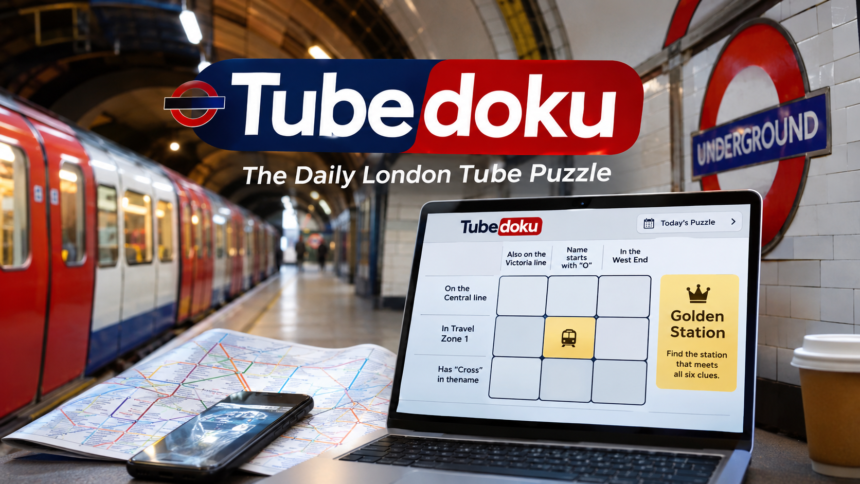
Tubedoku is a free daily online puzzle game that challenges players to identify London transport stations using clues about Tube lines, station names, locations, and travel zones. Inspired by Sudoku, the game uses a 3×3 grid where every answer must match two conditions. Players also have an extra challenge: finding the Golden Station that satisfies all six clues.
If you enjoy solving puzzles or know your way around the London Underground, Tubedoku offers an interesting way to test your knowledge. You don’t need to be a transport expert to get started, either. A little curiosity and some logical thinking can go a long way.
Here is everything you need to know about Tubedoku, including its rules, gameplay, useful strategies, and where to find the daily challenge.
What Is Tubedoku?
Tubedoku is an online logic puzzle based on London’s public transport network. It combines the familiar grid format of Sudoku with questions about real transport stations.
Instead of placing numbers into squares, you enter station names that satisfy particular conditions. These might relate to the lines serving a station, its location, or the spelling of its name.
The puzzle contains nine squares arranged in three rows and three columns. Each row and column has a different clue, giving players six conditions to consider.
What makes Tubedoku particularly enjoyable is that there can be several correct answers for an individual square. You need to think beyond the most obvious station, especially when completing the entire grid.
A new challenge appears every day, making it a convenient activity for commuters, puzzle enthusiasts, and anyone interested in London’s transport system.
Who Created Tubedoku?
Tubedoku was created by Sam Dawes, a London-based puzzle enthusiast with an interest in public transport.
The idea came from combining two things he enjoyed: daily logic games and the London Underground network.
In an interview with Londonist in October 2025, Dawes explained that the inspiration came while travelling on the Tube. He realised that London’s transport system could provide the foundation for a daily puzzle.
The game attracted attention from London-focused publications and developed a community of players who discuss challenges, share results, and compare strategies.
Tubedoku demonstrates how something familiar, such as a journey across London, can become an engaging puzzle.
How to Play Tubedoku
Playing Tubedoku is straightforward once you understand how its clues work.
Visit the official website at tubedoku.com and open the daily puzzle.
You will see a grid containing nine empty squares, with three clues for the rows and three for the columns.
Each square sits at the intersection of two clues. Your task is to identify a station that satisfies both of them.
Follow these steps to get started:
- Read the clues: Check the conditions assigned to each row and column.
- Choose a square: Start with an intersection where you recognise both conditions.
- Find a station: Think of a London transport station that matches both clues.
- Enter your answer: Select or type the station name using the game’s input system.
- Check the result: A correct answer turns green, while an incorrect answer turns red.
- Complete the grid: Continue until all nine squares have valid answers.
Remember that each square needs a different station. Finding a suitable answer for one position does not necessarily mean it is the best answer to use there.
Understanding the Tubedoku Rules
The main rule is simple: every station must satisfy its row clue and its column clue at the same time.
For example, imagine a square where the row asks for a station on the Central line and the column asks for a station served by the Victoria line.
Oxford Circus would be a valid answer because both lines serve that station.
However, a station that appears on only one of those lines would not meet both conditions.
The game also allows multiple possible solutions for many individual squares. This creates an interesting challenge because you may need to save a particular station for another position.
Another important rule concerns eligible stations. Tubedoku accepts stations from several London transport services, not just the traditional Underground network.
Understanding these rules makes the puzzle easier to approach and helps prevent unnecessary mistakes.
Which Stations Can You Use?
Tubedoku includes a wider range of transport services than its name might suggest.
According to the game’s official instructions, eligible stations come from the following networks:
- London Underground
- London Overground
- Elizabeth line
- Docklands Light Railway (DLR)
- London Trams (Tramlink)
- IFS Cloud Cable Car
This variety creates more possibilities than a game restricted to Underground stations alone.
For instance, a clue may relate to a tram stop or a station on the Elizabeth line. Players who only consider traditional Tube stations could overlook suitable answers.
However, stations served exclusively by Thameslink or other National Rail services are not included.
Checking the game’s accepted transport networks is particularly useful when an answer seems correct but is rejected.
What Is the Golden Station?
The Golden Station is one of Tubedoku’s most interesting features.
While an ordinary answer only needs to satisfy two conditions, the Golden Station meets all six clues across the puzzle.
That means it satisfies every row condition and every column condition, making it a particularly versatile answer.
Finding it requires more careful analysis than filling an individual square.
A station might initially appear to satisfy three or four clues, only to fail because its name or location does not match another condition.
One effective approach is to compare stations that serve several lines or appear to match multiple clues. Then check every remaining condition before deciding whether you have found the Golden Station.
It is also worth remembering that the Golden Station may be useful in several positions. Choosing where to place it can influence your other answers.
For many players, discovering this special station is the most satisfying part of completing the daily challenge.
Why Tubedoku Is Different From Sudoku
Although Tubedoku takes inspiration from Sudoku, the two games have important differences.
Traditional Sudoku uses a 9×9 grid and requires players to arrange numbers from 1 to 9 without repeating them within a row, column, or 3×3 box.
Tubedoku uses a smaller 3×3 grid and replaces numerical rules with questions about London transport stations.
The challenge depends on combining factual knowledge with logical reasoning.
Another difference is that Tubedoku can have several possible answers for a square. Players are not necessarily searching for one predetermined solution to the entire grid.
The Golden Station also introduces a separate objective that traditional Sudoku does not have.
These differences make Tubedoku accessible to people who enjoy word games, geography quizzes, and transport trivia, even if they rarely play Sudoku.
Best Strategies for Solving Tubedoku
A good strategy can make difficult Tubedoku puzzles much easier.
Start with familiar stations. Look for clues involving lines, areas, or station names you already know. Solving a few easy squares gives you a useful starting point.
Focus on restrictive clues. Some conditions are much harder to satisfy than others. If a clue allows only a small number of stations, consider solving those squares first.
Think about interchange stations. Stations served by multiple lines can be useful when two line-related conditions intersect. Familiarity with major interchanges helps you identify possibilities more quickly.
Save flexible answers. If one station satisfies several clues, avoid using it immediately. Another square may have fewer alternatives.
Check station names carefully. A clue involving the first letter, number of words, or a particular word requires attention to the exact station name.
Look for the Golden Station early. Even if you cannot identify it immediately, comparing the six clues can reveal which stations deserve closer attention.
Most importantly, don’t rush. A few seconds spent checking both conditions can prevent an incorrect guess.
Common Tubedoku Mistakes
One frequent mistake is checking only one condition.
A station might satisfy the row clue perfectly but fail the column clue. Because every square has two requirements, both must be checked before submitting an answer.
Another mistake is concentrating entirely on Underground stations.
Since Tubedoku includes the Overground, DLR, Elizabeth line, trams, and cable car, limiting your search to the Tube can make certain puzzles unnecessarily difficult.
Players can also run into problems by using a flexible station too early. An answer might be valid in one position but essential for another square with fewer possibilities.
Confusing similar station names is another potential issue. London has stations whose names look alike, so it is important to select the intended location.
Finally, remember that real-world service changes do not necessarily alter the puzzle’s accepted answers immediately. When unsure, check the station information used by the game.
Is Tubedoku Free to Play?
Yes, Tubedoku is free to play through its official website.
You can open the game in a web browser without purchasing a physical puzzle book or downloading a dedicated application.
This makes it convenient for people who want a quick challenge during their commute, lunch break, or free time.
The daily puzzle format also helps keep the experience manageable. Rather than presenting an overwhelming number of levels, the game gives players a fresh challenge to consider each day.
Because it is browser-based, you can access the website from a compatible computer, tablet, or smartphone.
Can You Play Previous Tubedoku Puzzles?
Yes. Tubedoku introduced a puzzle archive in March 2026, allowing players to revisit earlier daily challenges.
The archive includes puzzles dating back to August 1, 2025, when the game began.
According to the creator’s announcement, players can access previous puzzles using the puzzle number or calendar control near the top-left corner of the grid.
This is particularly helpful if you miss a day or want additional practice after completing the current puzzle.
The archive can also show your progress through previously played challenges. However, archived puzzles are separate from the current daily streak.
For anyone who wants more than one puzzle in a sitting, the archive offers an opportunity to explore older challenges without having to wait for the next day.
What Is Hardcore Mode?
Tubedoku has also offered a Hardcore Mode for players who prefer a more demanding experience.
As described in coverage by Secret London, this mode removes filtered station suggestions and asks players to enter their answers directly.
In the normal experience, suggestions can help you identify station names while typing.
Without those suggestions, players must rely more heavily on their own knowledge of London’s transport network.
This makes the challenge particularly appealing to experienced commuters and dedicated transport enthusiasts.
If the option is available in the current version of the game, it is worth trying after you become comfortable with the standard rules.
How Tubedoku Helps You Learn London Transport
Tubedoku is primarily an entertainment game, but it also provides opportunities to learn about London’s transport system.
Each puzzle encourages you to recall station names, identify line connections, and think about how different parts of the city fit together.
Over time, repeatedly considering these details may help you become more familiar with the network.
For example, you might discover that a station serves more lines than you expected or learn the name of a stop you have never visited.
The game can also encourage you to explore the official Transport for London maps.
These maps provide information about routes, stations, and connections across the city’s transport services.
Using them as a learning resource can make future puzzles easier while helping you understand London’s geography.
However, Tubedoku should not be used as a live journey planner. For current service conditions and travel information, rely on Transport for London’s official resources.
Other Games Similar to Tubedoku
If you enjoy Tubedoku, its official website also features related transport-themed puzzles.
Subwaydoku applies the same basic concept to the New York City Subway. Players identify stations that satisfy row and column conditions using knowledge of New York’s transport system.
Ldoku focuses on Chicago’s elevated rail network, commonly called the Chicago L. Its puzzles involve stations and lines operated by the Chicago Transit Authority.
Both games use a 3×3 grid and feature a Golden Station, giving them a familiar structure for existing Tubedoku players.
The main difference is the transport network you need to understand.
Exploring these games can be a fun way to learn about public transportation in other cities while enjoying the same style of logical challenge.
Why People Enjoy Tubedoku
One of Tubedoku’s strongest features is its simplicity.
The basic rules are easy to understand, yet finding suitable answers can require considerable thought.
For London commuters, the game has an additional appeal because it turns familiar station names into clues.
A stop you pass every morning might suddenly become the answer to a difficult puzzle.
The game also gives players something to discuss. Two people can approach the same grid differently and find different valid stations.
Unlike puzzles that depend entirely on general knowledge, Tubedoku rewards a combination of local familiarity, observation, and logical reasoning.
Its daily format makes it easy to fit into a routine without requiring a large time commitment.
FAQs About Tubedoku
1. What is Tubedoku?
Tubedoku is a free daily online puzzle based on London’s transport network. Players fill a 3×3 grid with station names that satisfy the clues assigned to each row and column.
2. How do you play Tubedoku?
Open the daily puzzle, read the row and column clues, and enter a valid station for each square. Every answer must satisfy both conditions. The aim is to complete all nine squares with different stations.
3. Is Tubedoku the same as Sudoku?
No. Tubedoku borrows Sudoku’s grid-based puzzle concept but replaces numbers with London transport stations. It also introduces a Golden Station that satisfies all six clues.
4. What is the Golden Station in Tubedoku?
The Golden Station is a special answer that meets all three row conditions and all three column conditions. Finding it provides an additional challenge beyond filling the nine squares.
5. Is Tubedoku free?
Yes. You can play the daily puzzle for free on the official Tubedoku website without purchasing the game.
6. Can I play Tubedoku on my phone?
Yes. Tubedoku is available through a web browser, allowing you to access the game on a compatible smartphone or tablet.
7. Does Tubedoku have a new puzzle every day?
Yes. A new puzzle is made available daily, giving players a different combination of clues and station possibilities.
8. Can I replay old Tubedoku puzzles?
Yes. The puzzle archive allows players to revisit earlier challenges, including puzzles dating back to August 2025.
9. Do I need to know every London Underground station?
No. Basic familiarity with the transport network can help, but you can gradually improve your knowledge through practice and research.
10. Does Tubedoku include the Elizabeth line and DLR?
Yes. Along with Underground stations, the game includes eligible stations from the Elizabeth line, DLR, London Overground, Tramlink, and IFS Cloud Cable Car.
11. Why was my Tubedoku answer marked incorrect?
Your answer may not satisfy both clues, may refer to an ineligible station, or may not match the station information accepted by the game. Always check the two conditions and the exact station name.
12. Who developed Tubedoku?
Tubedoku was created by Sam Dawes, who combined his interest in daily puzzles with his enthusiasm for London’s transport network.
13. Can more than one station be correct?
Yes. Many individual squares have several possible answers. However, you must use different stations across the grid and make sure every answer satisfies both conditions.
14. Where can I find today’s Tubedoku puzzle?
Visit tubedoku.com to access the latest daily puzzle and explore the game’s other transport-themed challenges.
Final Thoughts
Tubedoku offers a clever combination of transport knowledge and logical thinking. Its simple 3×3 grid is easy to understand, but the changing clues and Golden Station keep the daily challenges interesting.
Whether you travel on the London Underground regularly or simply enjoy solving puzzles, Tubedoku is an entertaining way to test your knowledge of London’s stations and routes.
The best way to improve is to play regularly, learn from unfamiliar answers, and pay attention to how the transport network connects.
If you’re ready to test yourself, visit the official Tubedoku website, open today’s puzzle, and see how many stations you can identify.